
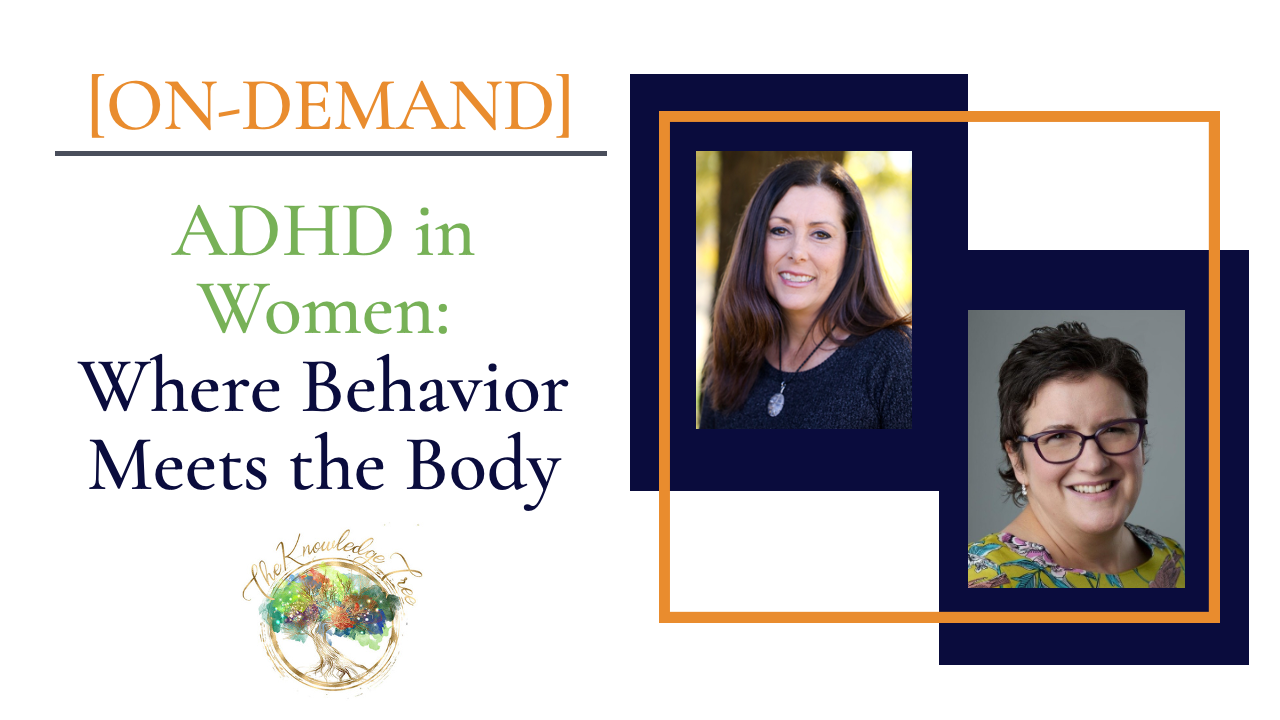
ADHD in Women: Where Behavior Meets the Body - 4 hours
To access the discount form for registering for multiple workshops or participants, please click here.
- CE Hours Included: 4 (please see below for details)
- Format: On-Demand Webinar (“Asynchronous”, Non-Interactive) ~ At your leisure this recorded video is to be viewed at your own pace. You may pause, rewind, and fast forward at any point during the videos. You are in complete control of how you view this workshop. It also comes with a PowerPoint and references. There is a quiz at the end to ensure viewing and required by all CE approval organizations.
- NOTE: Your certificate will be dated when you complete the course - Click here for more detailed information on the best way to do this: https://www.theknowledgetree.org/p/help
- Investment: $109 (provides lifetime access!)
- Presented by: Kristen Santos, OTR/L, CPCC and Ellen Baker, LPC, NCC, NBCFCH (see bio below)
- Date of Recording: August 19, 2026
- Instruction Level: Intermediate
- Target Audience: Psychologists, Counselors, Social Workers, Marriage & Family Therapists
- This workshop is not yet available; by pre-registering, you will receive immediate access when it becomes available in September.
Learning Objectives:
After completing this workshop in its entirety, you will be able to:
- Discuss how ADHD presents in women across the lifespan, including masking, late diagnosis, and the neurotypical expectations that contribute to burnout.
- Apply engagement-based activation tools to support performance and motivation in the ADHD nervous system.
- Identify how hormonal fluctuation across the menstrual cycle and perimenopause predictably affects access to executive function strategies and ADHD symptom expression.
- Demonstrate sensory diet tools and somatic interventions as complementary bottom-up approaches that address nervous system readiness.
Workshop Description:
This 4-hour interdisciplinary seminar examines ADHD in adults through the lens of nervous system regulation, bringing together mental health clinicians and occupational therapists around shared neurological mechanisms. Drawing on sensory integration, Barkley's executive function model, Dunn's Sensory Processing Model, and body-based practices from the mental health tradition, the seminar establishes regulation as the clinical intervention — the condition that makes all other treatment approaches accessible.
Through instructional presentation, case examples, reflective exercises, and practical clinical tools, participants build a working clinical approach applicable across disciplines. Particular emphasis is placed on expanding the toolkit for mental health clinicians to include body-based and sensory strategies grounded in nervous system science, and on understanding how those strategies and cognitive-behavioral approaches complement each other in practice.
Dedicated attention is given to cisgender women and girls with ADHD, including sensory and hormonal contributors to presentation, masking, and the pattern of late diagnosis that characterizes this population.
Workshop Agenda:
- Hour 1 — The Problem & The Person (60 minutes)
- Opening & Framing (10 min)
- Presenter introductions, credentials, and training logistics
- Overview of session structure, breaks, and end-of-session Q&A
- Large-group warm-up: What is one word your clients use to describe living with ADHD?
- The Origin Story — Why This Training Exists (10 min)
- Presenter's clinical career across the lifespan: pediatric, adult, and coaching settings
- Late ADHD diagnosis: what was missed and why
- Perimenopause as diagnostic amplifier
- Masking, neurotypical work expectations, and burnout as the clinical problem statement
- Learning objective addressed: LO 1
- Who We Are Talking About (10 min)
- DSM diagnostic criteria — brief overview
- How female ADHD presentation differs: inattentive predominance, misdiagnosis, and late identification
- Masking: definition, behaviors, and cumulative nervous system cost
- Interoceptive impairment as a consequence of chronic masking
- Learning objective addressed: LO 1
- ADHD as a Dysregulation System (10 min)
- Barkley's model: ADHD as a disorder of self-regulation across time, not attention alone
- Why behavioral strategies alone are insufficient: they assume regulatory capacity is already present
- The shame cycle: strategy failure attributed to character rather than neurology
- Learning objectives addressed: LO 1, LO 2
- Reflective Exercise (5 min)
- Attendees assess their own current arousal level and write initial observations to return to later in the session
- Barkley's Model — Externalizing the Brain (15 min)
- Core model: ADHD impairs internalization; behavior must be externalized
- Four externalizing strategies: time, tasks, consequences, motivation
- Point of Performance: intervention must occur where performance breaks down, not only in session
- Limits of top-down strategies without a regulated nervous system
- Learning objective addressed: LO 2
- Opening & Framing (10 min)
- Hour 2 — The Fuel System & The Hormonal Reality (60 minutes)
- Dodson's NICUP Model (25 min)
- Why traditional motivation frameworks fail the ADHD brain
- The five NICUP drivers: Novelty, Interest, Challenge, Urgency, Passion
- Clinical strategies for each driver
- Clinical cautions: NICUP tools require a regulated nervous system; urgency without regulation produces panic
- Evidence note: NICUP is a clinically derived model, widely used but not yet a peer-reviewed empirical framework
- Learning objective addressed: LO 2
- Estrogen, Dopamine & The Hormonal Reality (25 min) — Ellen Baker
- Estradiol's role in dopamine synthesis, receptor sensitivity, and reuptake modulation
- Symptom fluctuation across the menstrual cycle: menstruation, follicular, ovulation, luteal phases
- Perimenopause: irregular cycles, unpredictable ADHD symptom fluctuation, late diagnosis patterns
- Cycle Tracker worksheet walkthrough — clinical framing and client introduction
- Learning objectives addressed: LO 1, LO 2
- NICUP and Hormones — The Compounding Effect (10 min) — Both Presenters
- How hormonal phase affects NICUP access: luteal phase raises interest threshold, triggers anxiety with urgency
- Premenstrual NICUP failure frequently misread as treatment non-response
- Clinical adjustment: scale demands in low-estrogen phases; protect interest and passion areas as stabilizers
- Note: this is the presenters' clinical synthesis grounded in two separate evidence bases; not peer-reviewed as an integrated framework
- Learning objectives addressed: LO 1, LO 2
- Dodson's NICUP Model (25 min)
- Hour 3 — The Sensory Layer (60 minutes)
- Sensory Processing Co-Occurrence in ADHD (5 min)
- Sensory processing differences co-occur with ADHD at rates above chance — emerging, not settled research
- Pediatric evidence base is stronger; adult literature is growing
- A behavioral-only approach shortchanges clients whose sensory differences directly affect regulatory capacity
- Learning objective addressed: LO 3
- Dunn's Sensory Processing Model (20 min)
- Neurological threshold and behavioral response as the two organizing axes
- Four quadrant profiles: Low Registration, Sensation Seeking, Sensory Sensitive, Sensation Avoiding
- Clinical presentation and supports for each profile in an adult ADHD population
- Mixed profiles, hormonal shifts, and masking as complicating factors in profile identification
- Learning objective addressed: LO 3
- Reflective Exercise — Your Own Sensory Profile (5 min)
- Attendees complete sensory profile worksheet and identify their own dominant profile under stress
- The Three-Tier Sensory Support Model (15 min)
- Tier 1 — Environmental Design: reduce load before demands begin
- Tier 2 — Proactive Sensory Diet: individualized daily regulation built around the client's profile
- Tier 3 — Reactive Tools: address dysregulation after it occurs; effective but insufficient alone
- Central clinical argument: the ADHD nervous system does not return to baseline easily; proactive regulation is more effective than reactive regulation
- Learning objectives addressed: LO 3, LO 4
- The Sensory-Somatic Bridge (15 min) — Both Presenters
- Sensory diet activities and somatic interventions target the same neurological pathways — arriving from different disciplines but landing on the same nervous system targets
- Mechanism overview: deep pressure, vestibular-vagal connection, proprioceptive discharge, cold water dive reflex
- Brief Polyvagal Theory reference as mechanistic context only — not the primary framework for this training
- Discipline-neutral permission: sensory tools are not OT-exclusive; mental health clinicians can use them with competence
- Sensory autonomy in adults: the right to manage one's own nervous system without apology
- Learning objectives addressed: LO 3, LO 4
- Sensory Processing Co-Occurrence in ADHD (5 min)
- Hour 4 — Integration, Practice & The Clinician's Body (60 minutes)
- The Clinician's Nervous System (15 min) — Ellen Baker
- Co-regulation as a physiological reality: the client's nervous system is always in relationship with the clinician's
- A dysregulated clinician cannot co-regulate a dysregulated client
- Grounding and coherence practices for before, during, and after sessions
- A personal pre-session regulation routine as clinical infrastructure
- Learning objective addressed: LO 4
- Somatic Tools Across Disciplines (10 min) — Ellen Baker
- Bottom-up regulation menu organized by nervous system state (Handout 6)
- Hyperarousal tools vs. hypoarousal tools — not interchangeable; matching to state is required
- ADHD-specific note: post-overload shutdown often requires more gentleness than standard hypoarousal approaches
- Learning objective addressed: LO 4
- Exercise as Nervous System Intervention (10 min)
- Exercise is among the most well-supported non-pharmacological interventions for ADHD, with a robust evidence base across the lifespan
- Exercise increases dopamine and norepinephrine availability — the same neurotransmitters targeted by stimulant medication
- Barkley identifies exercise as a high-priority behavioral support for ADHD with direct impact on executive function and impulse regulation
- Even a single bout of moderate aerobic exercise produces measurable short-term improvements in attention, working memory, and inhibitory control
- Clinical framing: exercise is a nervous system intervention, not only a lifestyle recommendation; timing before high-demand tasks matters
- Proactive use parallels Tier 2 sensory diet logic: scheduled before demands, not only reactive
- Learning objectives addressed: LO 3, LO 4
- Case Studies (10 min) — Both Presenters
- Case 1 (Kristen): Maya, 58, attorney — chronic overwhelm, weekly shutdown, prior GAD diagnosis, strategies not sticking
- Discussion: sensory profile identification, regulation-first sequencing, masking cost, environmental design
- Case 2 (Ellen): Sandra, 40, school counselor — late ADHD diagnosis, inconsistent stimulant response, questioning the diagnosis
- Discussion: hormonal factors in medication response, cycle tracker introduction, distinguishing hypo- from hyperarousal
- Learning objectives addressed: LO 1, LO 2, LO 3, LO 4
- Reflective Exercise (2 min)
- Attendees identify one tool or concept to bring to a current client Monday morning
- Closing & Key Takeaways (3 min) — Both Presenters
- ADHD in women is shaped by neurology, hormones, sensory processing, and masking — no single approach captures this alone
- Top-down strategies work when the nervous system can access them; bottom-up tools create that access
- The clinician's nervous system is a clinical instrument
- Learning objectives addressed: LO 1, LO 2, LO 3, LO 4
- Q&A — 10 minutes
- The Clinician's Nervous System (15 min) — Ellen Baker
Presented by:
Kristen Santos, OTR/L, CPCC

Ellen Baker, LPC, NCC, NBCFCH

Ellen Baker is a Licensed Professional Counselor and runs a solo private practice, Counseling with Heart, in the north metro Atlanta area. Ellen received her BA in Psychology from Emory University in 1989 and her MS in Community Counseling from Georgia State University in 1997. She began her career as a counselor, working with youth in residential care and providing strengths-based, family-focused services. She later transitioned to foster care, working for a private agency as a program supervisor. After several years in this role, she became a state trainer for this same agency, providing training, clinical consultation, and program oversight for program employees and providers.
Ellen began her private practice in 2013. She enjoys helping clients who are managing symptoms of depression, anxiety, and the impact of trauma. She is also committed to supporting fellow therapists in their personal healing work. Ellen is an Advanced Certified Clinical Hypnotherapist and a National Board Certified Fellow in Clinical Hypnotherapy (NBCFCH) through the National Board for Certified Clinical Hypnotherapists (NBCCH). She received a Clinical Certification for Stress Management and Emotional Management from HeartMath and is a HeartMath Certified Trainer. She has advanced training in Brainspotting, EMDR, EFT (tapping), and IADC therapy. She also offers coaching, training, and consultation services. Ellen values the power of using brain/body approaches and energy psychology to facilitate healing and growth for her clients.
4 "Asynchronous" CE Hours Included - Details by License Type Below:
- PSYCHOLOGISTS: The Knowledge Tree, A Summit Professional Education Company is approved by the American Psychological Association to sponsor continuing education for psychologists. The Knowledge Tree, A Summit Professional Education Company maintains responsibility for this program and its content. For more detailed information on the current CE ruling in Georgia, or if you are licensed in another state or country, please click here.
- COUNSELORS: The Knowledge Tree, A Summit Professional Education Company has been approved by the National Board for Certified Counselors (NBCC) as an Approved Continuing Education Provider (ACEP), ACEP No. 7153. Programs that do not qualify for NBCC credit are clearly identified. The Knowledge Tree, A Summit Professional Education Company is solely responsible for all aspects of the programs.
- GA: Counselors in GA will receive 4 Core Hours for completing this course. Please click here for more detailed information.
- SOCIAL WORKERS: The Knowledge Tree, a Summit Professional Education
Company, provider #2470, is approved as an ACE provider to offer social work
continuing education by the Association of Social Work Boards (ASWB) Approved
Continuing Education (ACE) program. Regulatory boards are the final authority
on courses accepted for continuing education credit. ACE provider approval
period: 1/14/2026-1/14/2027. Social workers completing this course receive 4 clinical continuing education credits.
- GA: Social Workers in GA will receive 4 Core Hours for completing this course. Please click here for more detailed information.
- MARRIAGE & FAMILY THERAPISTS: This workshop is approved for 4 Core CE hours through the Georgia Association for Marriage & Family Therapy (GAMFT), approval # 140-2026. If you are licensed in another state or country, please click here for more detailed information.
Registration: To register for individual workshops, you may use our online payment option, or to pay by check you may print and complete the Registration Form and mail or fax it to our office. The registration form is available on our website: www.theknowledgetree.org. Registration is permitted until the time the workshop begins, unless otherwise specified.
Multiple Workshop Special: There is a 10% Discount with registration for two workshops. There is a 15% Discount with registrations for three or four workshops. There is a 20% Discount with registration for five or more workshops.
Refund/Cancellation Policy: If you can no longer attend a workshop you have registered for, you can either receive a credit for another workshop or receive a refund if you are within the refund policy period. Refunds will be given for cancellations received at least five days prior to the workshop. More information about refund/cancellation can be found here.
Attendance Policy: 100% attendance, completion of a course evaluation and passing a post-test with a score of 70% or higher (you will have 2 retake opportunities) is required at any asynchronous CE program in order to receive credit for that CE program. No partial credit is given. Certificates of completion will be available in each attendee’s account once these completion requirements have been met.
ADA Requests: We will make every effort to accommodate any reasonable ADA request. Please call or email us at least two weeks prior to the event. Payment and registration are required to fulfill an ADA request.
No Conflict Policy: Neither The Knowledge Tree nor its speakers have received any commercial support for this program or its contents and will not receive any commercial support prior to or during this program.
System Requirements: Live Interactive Webinars are facilitated via Zoom. System requirements for the Zoom platform are linked at our FAQ page.
We are an approved vendor for the U.S. Department of Veterans Affairs for easy reimbursement of educational expenses for VA employees.
Get Started!
|
For information about our Continuing Education Workshops, please contact our Customer Service team at: theknowledgetree@summit.zendesk.com |
Sign Up for Our Newsletter
Stay up to date with the latest courses, announcements, and articles.


