
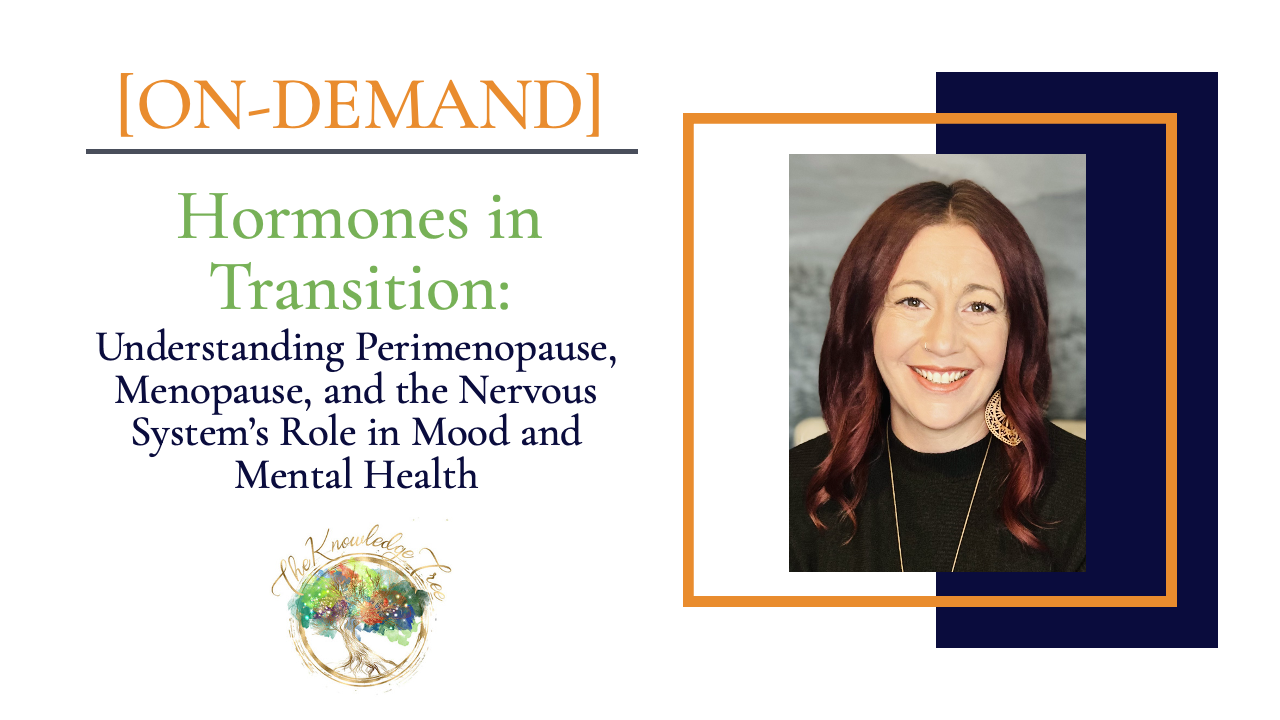
Hormones in Transition: Understanding Perimenopause, Menopause, and the Nervous System’s Role in Mood and Mental Health
To access the discount form for registering for multiple workshops or participants, please click here.
- CE Hours Included: 4 (please see below for details)
- Format: On-Demand Webinar (“Asynchronous”, Non-Interactive) ~ At your leisure this recorded video is to be viewed at your own pace. You may pause, rewind, and fast forward at any point during the videos. You are in complete control of how you view this workshop. It also comes with a PowerPoint and references. There is a quiz at the end to ensure viewing and required by all CE approval organizations.
- NOTE: Your certificate will be dated when you complete the course - Click here for more detailed information on the best way to do this: https://www.theknowledgetree.org/p/help
- Investment: $109 (provides lifetime access!)
- Presented by: Krista Day-Gloe, LCSW (see bio below)
- Date of Recording: October 21, 2026
- Instruction Level: Intermediate
- Target Audience: Psychologists, Counselors, Social Workers, Marriage & Family Therapists
- This workshop is not yet available; by pre-registering, you will receive immediate access when it becomes available in November.
Learning Objectives:
After completing this workshop in its entirety, you will be able to:
- Compare how AMAB hormone pattern research has influenced gaps in AFAB hormonal understanding and education.
- Outline hormonal changes across AFAB life stages, with a focus on perimenopause and menopause, and their impact on mood, sleep, and cognition.
- Discuss how estrogen, progesterone, and testosterone interact with the nervous system to influence stress tolerance, emotional regulation, and clinical presentation.
- Utilize hormone-informed assessment strategies to support clinical assessment, case conceptualization, and treatment planning during hormonal transitions.
Workshop Description:
Many clinicians and medical providers receive little to no training on how hormones influence our physical and mental health. For decades, research, diagnostic frameworks, and clinical assessments have largely been based on male hormonal patterns, often overlooking the cyclical and transitional hormonal changes experienced by individuals assigned female at birth (AFAB). As a result, many clinicians were never taught how hormonal differences—and major hormonal life stage transitions across the AFAB lifespan—can influence mood, cognition, and behavior.
Yet millions of individuals experience significant emotional, cognitive, and physiological changes during hormonal transitions, particularly during perimenopause and menopause.
Fluctuations in estrogen, progesterone, and testosterone during this stage of life can influence neurotransmitters, sleep regulation, stress response, metabolic functioning, and emotional processing. These changes often present clinically as anxiety, depression, cognitive fog, irritability, or sleep disruption—symptoms that may be misinterpreted as purely psychiatric conditions.
This workshop provides clinicians with a practical, research-informed overview of hormonal physiology across the lifespan, with a primary focus on perimenopause and menopause.
Participants will learn how hormonal transitions interact with the nervous system and influence mood, cognition, and stress tolerance, and how to better recognize hormone-related patterns that may affect clinical presentation and treatment planning. Participants will leave with practical strategies for incorporating hormone-informed perspectives into assessment, case conceptualization, and treatment planning.
Workshop Agenda:
- Foundations: Hormones and Mental Health (45 minutes)
- Overview of hormones and their impact on mental health
- Relationship between the endocrine system and brain function
- Influence of hormones on mood, cognition, sleep, and behavior
- Historical reliance on AMAB hormonal templates in research, diagnosis, and clinical frameworks
- How male-based research models shaped diagnostic criteria
- Limitations of applying AMAB hormonal frameworks to AFAB individuals
- Differences between AFAB and AMAB hormonal patterns
- Cyclical hormonal patterns in AFAB individuals
- More stable daily hormonal patterns in AMAB individuals
- Implications for mental health presentation and assessment
- Overview of the endocrine system and primary reproductive hormones in AFAB individuals
- Hypothalamic–pituitary–gonadal (HPG) axis
- Estrogen
- Progesterone
- Testosterone
- Overview of the 28-day AFAB hormonal cycle
- Follicular phase
- Ovulation
- Luteal phase
- Menstruation
- Roles of estrogen, progesterone, and testosterone across the cycle
- Hormonal influences on neurotransmitters such as serotonin, dopamine, and GABA
- Effects of hormonal shifts on mood, sleep regulation, and cognitive function
- Overview of hormones and their impact on mental health
- Hormones, the Nervous System, and Mental Health (45 minutes)
- Interaction between hormones and the nervous system
- Relationship between hormonal fluctuations and nervous system regulation
- Overview of Polyvagal Theory and the Window of Tolerance
- Nervous system states and emotional regulation
- Impact of hormonal changes on nervous system stability
- Overview of the stress response and the role of cortisol
- Hypothalamic–pituitary–adrenal (HPA) axis
- Acute vs. chronic stress responses
- Hormonal influences on stress tolerance and emotional regulation
- Effects of estrogen, progesterone, and testosterone on neurotransmitter systems
- Influence of hormonal shifts on cognition, attention, and executive functioning
- Nervous system regulation during hormonal transitions
- Clinical considerations
- Differentiating hormonal influences from primary psychiatric diagnoses
- Understanding symptom variability across hormonal transitions
- Recognizing when hormonal transitions may contribute to anxiety, depression, or cognitive symptoms
- Interaction between hormones and the nervous system
- Hormonal Cycles and Life Stage Transitions in AFAB Individuals (90 minutes)
- AFAB hormonal transitions across the lifespan
- Puberty and reproductive years
- Hormonal changes during puberty
- Clinical impact on mood, behavior, and identity development
- Pregnancy and postpartum
- Hormonal shifts during pregnancy
- Postpartum hormonal changes
- Clinical impact on mood regulation and mental health
- Perimenopause transition and hormonal variability
- Changes in estrogen and progesterone patterns
- Increased hormonal fluctuation and symptom variability
- Common clinical presentations during perimenopause
- Mood symptoms
- Irritability
- Cognitive fog
- Sleep disruption
- Physical changes
- Treatments often used during the perimenopause transition
- Hormone replacement therapy (HRT)
- Hormonal contraceptives
- Non-hormonal medications
- Antidepressants and other psychiatric medications
- Lifestyle and nervous system regulation strategies
- Integrative or supportive approaches
- Menopause and post-menopausal hormonal changes
- Decreased estrogen and progesterone levels
- Changes in metabolic and neurological functioning
- Common clinical presentations during menopause
- Sleep disturbance
- Mood symptoms
- Cognitive changes
- Physical changes
- Vasomotor symptoms (hot flashes, night sweats)
- Treatments often used during menopause
- Hormone replacement therapy
- Non-hormonal medications
- Antidepressants and other psychiatric medications
- Lifestyle and nervous system regulation strategies
- Integrative or supportive approaches
- Clinical Assessment, Coping Strategies, and Treatment Planning (60 minutes)
- Identifying hormone-related symptom patterns in clinical practice
- Integrating hormone literacy into clinical assessment and case conceptualization
- Recognizing patterns in mood, sleep, cognition, and behavior related to hormonal shifts
- Clinical tools
- Hormone-informed symptom tracking
- Pattern recognition across menstrual and hormonal transitions
- Nervous system regulation strategies for mood and stress tolerance
- Coordination of care with medical providers
- Treatment planning considerations
- Supporting clients navigating perimenopause and menopause
- Integrating hormonal awareness into psychotherapy and treatment planning
- Collaboration with medical providers and interdisciplinary care
- Helpful resources for clinicians and clients
Presented by: Krista Day-Gloe, LCSW

Krista Day-Gloe, LCSW, is a licensed clinical social worker and founder of Healing Roots Wellness Center. She specializes in translating complex science into practical, understandable concepts related to hormonal health, nervous system regulation, chronic health conditions, and disordered eating, using a bottom-up approach to clinical practices. Through her Body-Led Mental Health framework, Krista teaches clinicians how physiological processes—including hormonal fluctuations—shape mood, cognition, stress tolerance, and behavior across the lifespan.
Krista is the author of Mood & Moon: A Body-Led Guide for Cycling Bodies and Body-Led Mental Health on Substack. She regularly provides training for mental health professionals on hormone-informed clinical care. Her work focuses on helping clinicians recognize how endocrine shifts—including menstrual cycles, perimenopause, and menopause—interact with the nervous system and influence symptoms that are often misattributed solely to psychiatric diagnoses.
As a clinician working directly with clients navigating hormonal transitions and complex health conditions, she integrates current research on endocrinology, neuroscience, and
trauma-informed care into practical frameworks that clinicians can apply immediately in assessment, case conceptualization, and treatment planning.
4 "Asynchronous" CE Hours Included - Details by License Type Below:
- PSYCHOLOGISTS: The Knowledge Tree, A Summit Professional Education Company is approved by the American Psychological Association to sponsor continuing education for psychologists. The Knowledge Tree, A Summit Professional Education Company maintains responsibility for this program and its content. For more detailed information on the current CE ruling in Georgia, or if you are licensed in another state or country, please click here.
- COUNSELORS: The Knowledge Tree, A Summit Professional Education Company has been approved by the National Board for Certified Counselors (NBCC) as an Approved Continuing Education Provider (ACEP), ACEP No. 7153. Programs that do not qualify for NBCC credit are clearly identified. The Knowledge Tree, A Summit Professional Education Company is solely responsible for all aspects of the programs.
- GA: Counselors in GA will receive 4 Core Hours for completing this course. Please click here for more detailed information.
- SOCIAL WORKERS: The Knowledge Tree, a Summit Professional Education
Company, provider #2470, is approved as an ACE provider to offer social work
continuing education by the Association of Social Work Boards (ASWB) Approved
Continuing Education (ACE) program. Regulatory boards are the final authority
on courses accepted for continuing education credit. ACE provider approval
period: 1/14/2026-1/14/2027. Social workers completing this course receive 4 general continuing education credits.
- GA: Social Workers in GA will receive 4 Core Hours for completing this course. Please click here for more detailed information.
- MARRIAGE & FAMILY THERAPISTS: This workshop is approved for 4 Core CE hours through the Georgia Association for Marriage & Family Therapy (GAMFT), approval # 160-2026. If you are licensed in another state or country, please click here for more detailed information.
Registration: To register for individual workshops, you may use our online payment option, or to pay by check you may print and complete the Registration Form and mail or fax it to our office. The registration form is available on our website: www.theknowledgetree.org. Registration is permitted until the time the workshop begins, unless otherwise specified.
Multiple Workshop Special: There is a 10% Discount with registration for two workshops. There is a 15% Discount with registrations for three or four workshops. There is a 20% Discount with registration for five or more workshops.
Refund/Cancellation Policy: If you can no longer attend a workshop you have registered for, you can either receive a credit for another workshop or receive a refund if you are within the refund policy period. Refunds will be given for cancellations received at least five days prior to the workshop. More information about refund/cancellation can be found here.
Attendance Policy: 100% attendance, completion of a course evaluation and passing a post-test with a score of 70% or higher (you will have 2 retake opportunities) is required at any asynchronous CE program in order to receive credit for that CE program. No partial credit is given. Certificates of completion will be available in each attendee’s account once these completion requirements have been met.
ADA Requests: We will make every effort to accommodate any reasonable ADA request. Please call or email us at least two weeks prior to the event. Payment and registration are required to fulfill an ADA request.
No Conflict Policy: Neither The Knowledge Tree nor its speakers have received any commercial support for this program or its contents and will not receive any commercial support prior to or during this program.
System Requirements: Live Interactive Webinars are facilitated via Zoom. System requirements for the Zoom platform are linked at our FAQ page.
We are an approved vendor for the U.S. Department of Veterans Affairs for easy reimbursement of educational expenses for VA employees.
Get Started!
|
For information about our Continuing Education Workshops, please contact our Customer Service team at: theknowledgetree@summit.zendesk.com |
Sign Up for Our Newsletter
Stay up to date with the latest courses, announcements, and articles.


