
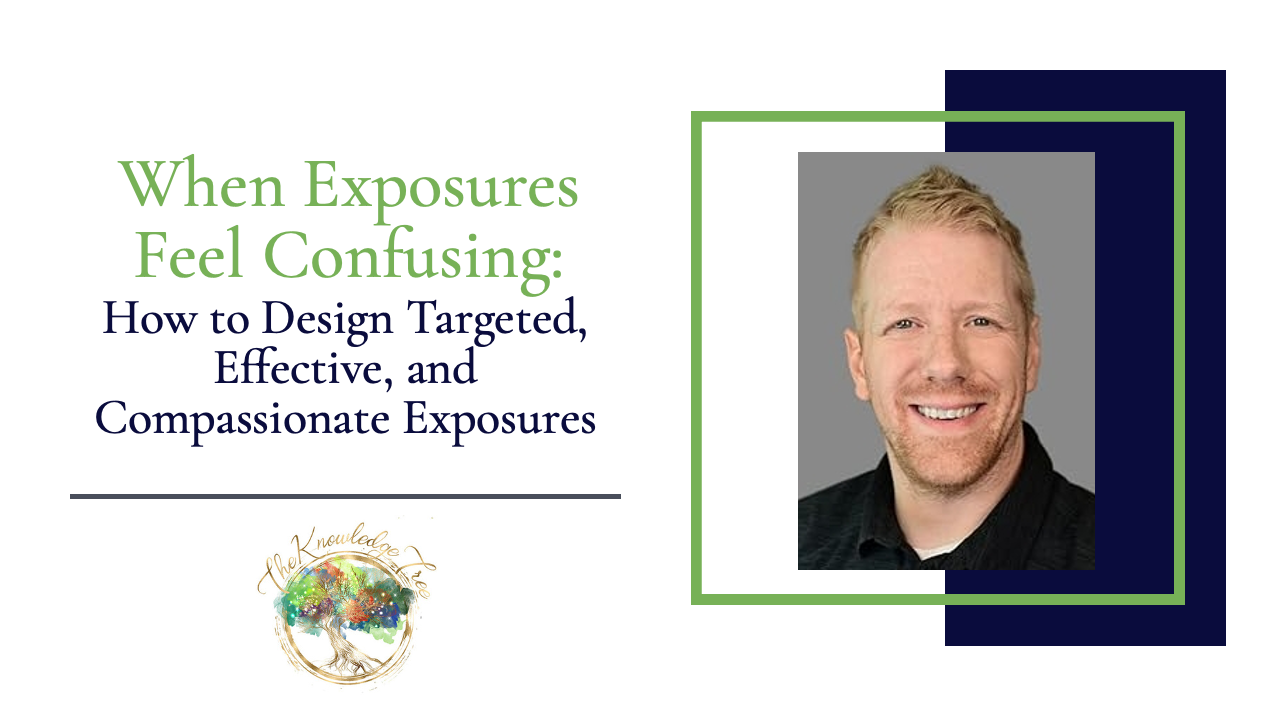
When Exposures Feel Confusing: How to Design Targeted, Effective, and Compassionate Exposures - 3 hours
To access the discount form for registering for multiple workshops or participants, please click here.
When & Where:
- Date: Friday, October 9, 2026
- If you cannot attend this workshop on 10/9, you can pre-register for the on-demand version here: https://www.theknowledgetree.org/p/when-exposures-...
- Time: 1:00pm - 4:15pm Eastern Time
- CE Hours Included: 3 (please see below for details)
- Location: Live Interactive Webinar ("Synchronous") on Zoom
- Investment: $87 before Friday, September 25th at 5:00pm Eastern Time, $97 after
- Presented by: Michael Stier, LCPC, LPC, NCC (see bio below)
- Workshop Recording: A recording of this workshop is available to review for 60 days after the presentation. However, participants must attend live to receive the "Synchronous" CE Certificate.
- Instruction Level: Intermediate
- Target Audience: Psychologists, Counselors, Social Workers, Marriage & Family Therapists
Learning Objectives:
After completing this workshop in its entirety, you will be able to:
- Describe the theoretical differences between habituation theory and inhibitory learning theory and how each informs the implementation of exposure-based interventions.
- Analyze emotional avoidance and safety behaviors that maintain anxiety and OCD symptoms and interfere with exposure-based treatment.
- Apply inhibitory learning principles to construct individualized exposure menus that target avoidance and promote meaningful therapeutic learning.
Workshop Description:
This presentation will help clinicians reduce confusion and increase confidence when designing exposure-based interventions for OCD and anxiety disorders. Although exposure therapy is one of the most effective psychological treatments available, many clinicians struggle to determine what the exposure should target, how to identify the core fear, and how to create interventions that are both therapeutically effective and compassionate. Participants will learn a practical framework for conceptualizing and developing exposures that align with evidence-based principles while remaining individualized to each client's presentation. Through numerous case examples and clinical scenarios, attendees will gain concrete strategies for translating theory into practice and making more precise treatment decisions when faced with complex or ambiguous clinical presentations.
The training will also emphasize the role of identity, culture, lived experience, and contextual factors in exposure design. Exposure exercises are learning experiences whose meaning and impact can vary significantly based on a client's background, rather than relying on standardized menus or assumptions about what a client should fear. Participants will learn how to develop culturally responsive exposures that are informed by each client's unique background. Practical examples will illustrate how to adapt exposure interventions across diverse presentations while maintaining fidelity to evidence-based treatment principles, ultimately enhancing engagement, therapeutic alliance, and clinical outcomes.
Workshop Agenda:
- Section 1: The History and Science of Exposure Therapy (30 mins)
- Why clinicians avoid assigning exposures and the consequences of ERP underutilization.
- Behavioral foundations of exposure therapy, including classical conditioning and Mowrer's two-factor theory.
- Understanding the habituation model and how it shaped exposure therapy for decades.
- Reviewing the inhibitory learning model and the principle of expectancy violation.
- Comparing habituation and inhibitory learning approaches and examining how each model influences clinical decision-making.
- Section 2: Emotional Avoidance as the Core Clinical Target (30 mins)
- Defining emotional avoidance and its role in maintaining anxiety and OCD.
- Examining overt avoidance, subtle avoidance, and cognitive avoidance strategies.
- Understanding safety behaviors and how they interfere with exposure-based learning.
- Learning to identify avoidance patterns when designing treatment plans and exposure hierarchies.
- Section 3: Busting the Myths of ERP (30 mins)
- Exploring the origins of common misconceptions about exposure therapy.
- Addressing the myth that ERP is cruel, harsh, or traumatizing.
- Examining the misconception that anxiety must decrease during exposures for treatment to work.
- Understanding why complete menus are not required before beginning treatment.
- Discussing ERP within trauma-informed frameworks and addressing the myth that clients must be fully "ready" before beginning exposures.
- Section 4: When Exposures Go Wrong — Harmful Uses and Misapplications (30 mins)
- Understanding how coercive or poorly paced exposures can undermine treatment.
- Identifying therapist accommodation and avoidance that interfere with effective ERP.
- Recognizing the impact of safety behaviors during exposures.
- Examining the consequences of inadequate psychoeducation and rationale development.
- Reviewing ethical considerations and common pitfalls in exposure-based treatment.
- Section 5: Setting Up and Debriefing Exposures (40 mins)
- Using inhibitory learning principles to design effective exposures.
- Identifying feared predictions and developing expectancy-violating experiences.
- Building variability and flexibility into exposure exercises.
- Conducting post-exposure debriefs that consolidate learning while avoiding reassurance-seeking.
- Section 6: Cultural Considerations and Wrap-Up (20 mins)
- Examining cultural influences on OCD, anxiety, rituals, and avoidance behaviors.
- Differentiating cultural and religious practices from compulsive behaviors.
- Developing culturally responsive exposure hierarchies and treatment rationales.
- Understanding the therapist's role in managing personal discomfort, assumptions, and cultural biases during ERP implementation.
Presented by: Michael Stier, LCPC, LPC, NCC
 Michael Stier is a Licensed Clinical Professional Counselor (LCPC) in Illinois, an LPC in Georgia and Missouri, and a National Certified Counselor (NCC) specializing in OCD and related disorders. He currently serves as the Director of Education and Training at Anxiety Specialists of Atlanta, overseeing evidence-based treatment interventions. Michael is also faculty for the Behavioral Therapy Training Institute (BTTI) through the International OCD Foundation (IOCDF). He co-authored The Complete Guide to Overcoming Health Anxiety and developed the associated Overcoming Health Anxiety website, which provides evidence-based information and support for individuals with health anxiety, as well as their families and loved ones.
Workshop Schedule (Eastern Time):
- 12:30pm - 1:00pm | Sign-In and Welcome
- 1:00pm - 2:30pm | Session
- 2:30pm - 2:45pm | Break
- 2:45pm - 4:15pm | Session
- 4:15pm | Continuing Education Certificates Available
3 CE Hours Included - Details by License Type Below:
- PSYCHOLOGISTS: The Knowledge Tree, A Summit Professional Education Company is approved by the American Psychological Association to sponsor continuing education for psychologists. The Knowledge Tree, A Summit Professional Education Company maintains responsibility for this program and its content. For more detailed information on the current CE ruling in Georgia, or if you are licensed in another state or country, please click here.
- COUNSELORS: The Knowledge Tree, A Summit Professional Education Company has been approved by the National Board for Certified Counselors (NBCC) as an Approved Continuing Education Provider (ACEP), ACEP No. 7153. Programs that do not qualify for NBCC credit are clearly identified. The Knowledge Tree, A Summit Professional Education Company is solely responsible for all aspects of the programs.
- GA: Counselors in GA will receive 3 Core Hours for completing this course. Please click here for more detailed information.
- SOCIAL WORKERS: The Knowledge Tree, a Summit Professional Education Company, provider #2470, is approved as an ACE provider to offer social work continuing education by the Association of Social Work Boards (ASWB) Approved Continuing Education (ACE) program. Regulatory boards are the final authority on courses accepted for continuing education credit. ACE provider approval period: 1/14/2026-1/14/2027. Social workers completing this course receive 3 clinical continuing education credits.
- GA: Social Workers in GA will receive 3 Core Hours for completing this course. Please click here for more detailed information.
- MARRIAGE & FAMILY THERAPISTS: TKT has applied for approval for this workshop through the Georgia Association for Marriage & Family Therapy (GAMFT). If you are licensed in another state or country, please click here for more detailed information.
Registration: To register for individual workshops, you may use our online payment option, or to pay by check you may print and complete the Registration Form and mail or fax it to our office. The registration form is available on our website: www.theknowledgetree.org. Registration is permitted until the time the workshop begins, unless otherwise specified.
Multiple Workshop Special: There is a 10% Discount with registration for two workshops. There is a 15% Discount with registrations for three or four workshops. There is a 20% Discount with registration for five or more workshops.
Refund/Cancellation Policy: If you can no longer attend a workshop you have registered for, you can either receive a credit for another workshop or receive a refund if you are within the refund policy period. Refunds will be given for cancellations received at least five days prior to the workshop. More information about refund/cancellation can be found here.
Attendance Policy: 100% attendance and completion of a course evaluation is required at any CE program in order to receive credit for that CE program. No partial credit is given. Certificates of completion will be available in each attendee’s account once the broadcast has ended and the course evaluation completed.
ADA Requests: We will make every effort to accommodate any reasonable ADA request. Please call or email us at least two weeks prior to the event. Payment and registration are required to fulfill an ADA request.
No Conflict Policy: Neither The Knowledge Tree nor its speakers have received any commercial support for this program or its contents and will not receive any commercial support prior to or during this program.
System Requirements: Live Interactive Webinars are facilitated via Zoom. System requirements for the Zoom platform are linked at our FAQ page.
We are an approved vendor for the U.S. Department of Veterans Affairs for easy reimbursement of educational expenses for VA employees.
Get Started!
|
For information about our Continuing Education Workshops, please contact our Customer Service team at: theknowledgetree@summit.zendesk.com |
Sign Up for Our Newsletter
Stay up to date with the latest courses, announcements, and articles.


