
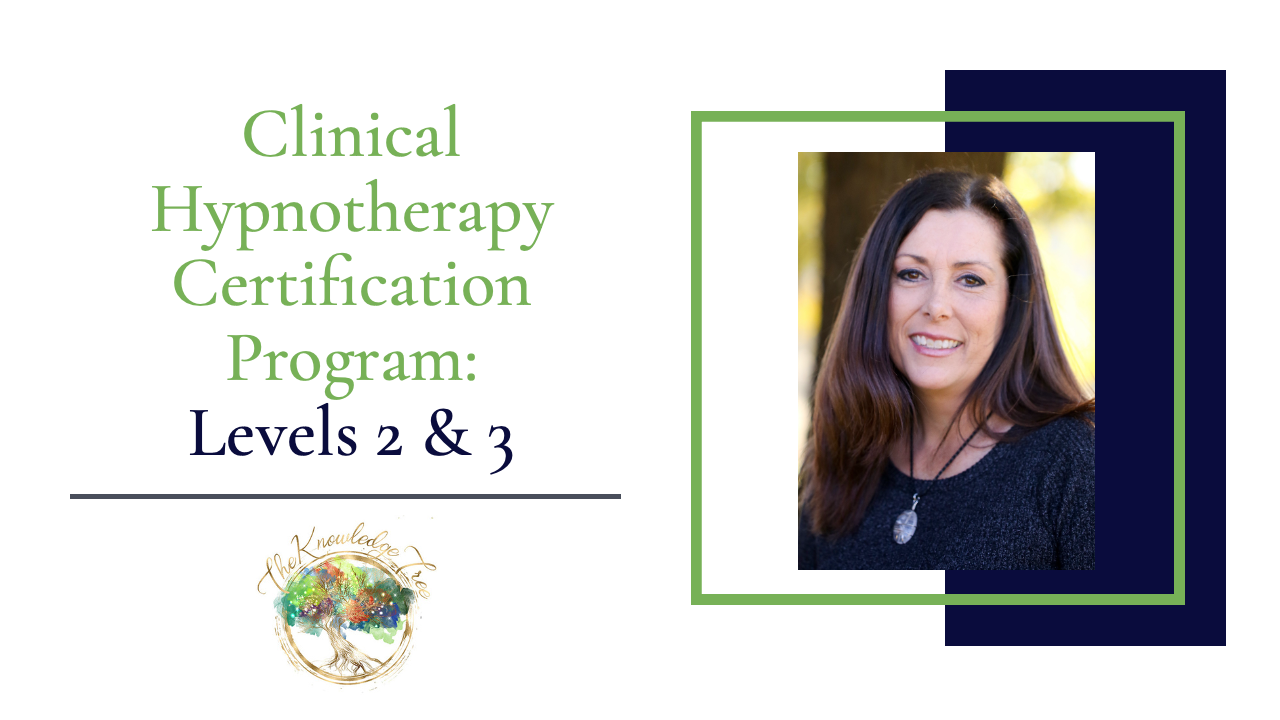
Clinical Hypnotherapy Certification Program (Levels 2 & 3) - 53 hours
When & Where:
- Date: Friday-Sunday, September 11-13 & 25-27, 2026
- Additionally, you are required to
- Complete ten (10) 1-hour practice sessions on your own
- Attend a 3-hour consultation session with Ellen Baker (at no additional cost) in order to complete the certification. You have two options for dates/times to attend:
- Saturday, October 17, 2026 from 9:00am - 12:15pm Eastern Time, OR Friday, October 23, 2026 from 12:00pm - 3:25pm Eastern Time
- You are only required to attend ONE of these consultation sessions, and it is your choice which of the two dates to attend.
- Complete ten (10) 1-hour practice sessions on your own
- Additionally, you are required to
- Time: 10:00am - 5:45pm Eastern Time EACH DAY
- CE Hours Included: 43 "Synchronous"
- Approved by the National Board for Certified Clinical Hypnotherapists (NBCCH)!
- Location: Live Interactive Webinars ("Synchronous") with Breakout Rooms on Zoom
- Investment: $1499 before Friday, August 14th at 5:00pm Eastern Time, $1749 after
- A monthly payment plan is available; please see below for details
- Presented by: Ellen Baker, LPC, NCC, NBCFCH (see bio below)
- Instruction Level: Intermediate
- Target Audience: Psychologists, Counselors, Social Workers, Marriage & Family Therapists
- REQUIRED PREREQUISITE: Hypnotherapy with Memory Reconsolidation (Level 1) (previously taken as a live or on-demand workshop; if you have not taken this workshop yet, you can sign up for the on-demand version here). Additionally, only mental health clinicians with at least a master's degree may take this training. The master's or doctoral degree must be in counseling, mental health, social work, marriage and family therapy, or psychology.
Workshop Description:
This unique program concludes with participants receiving the Certified Clinical Hypnotherapy (CCH) designation and meets the training standards of the National Board for Certified Clinical Hypnotherapists for professionals seeking additional NBCCH certification. This course enables the trainees to develop practical skills through didactic teaching, observation of the instructor performing each technique, personal experience, and supervised hypnotherapy practice sessions. The training covers clinically targeted applications of several effective methods and techniques that combine hypnotherapy with several theoretical models. Each day begins with a guided hypnotic experience. Next, your instructor will provide a didactic description of a new technique, followed by a demonstration of the technique. Participants will then spend the afternoon practicing what they have learned during the morning session. This allows participants to deeply assimilate the information on both a cognitive and experiential level. Your instructor and several licensed therapists certified in hypnotherapy will supervise sessions in virtual breakout rooms. The assistants will also be available for questions throughout the workshop and will convey important information in the chat during demonstrations, letting you know what to pay attention to. Previous attendees have described the course as "life-changing" for them, both personally and professionally. The course includes lifetime access to all materials, including multiple interview templates, scripts, organized note-taking forms, and other resources. It also includes access to the training videos recorded during the workshop, as well as bonus demonstration videos from previous workshops, for review and deeper understanding.
Participants will have the opportunity, within the first month of training, to engage in an additional consultation experience designed to support integration and confidence in clinical application. This group consultation will include focused instruction on key concepts, opportunities for questions and discussion, and guided practice to support skill development. The consultation is structured to provide a collaborative environment in which participants can refine clinical application, receive feedback, and strengthen competency in the use of hypnotherapy interventions.
Following initial application of skills in practice, participants will also have the opportunity to present technical questions, discuss clinical challenges, and receive targeted guidance to support continued development.
Participants may choose to attend one of two consultation sessions offered. Attendance at one session is required to meet the 43 synchronous hours requirement for certification.
*Certification requirements: 1) Having a graduate degree in mental health (as described above); 2) Attendance for the entire course (43 hours) and Level 1: Hypnotherapy with Memory Reconsolidation taught by Dr. Beaton York (7 hours); 3) Completion of 10 practice sessions (for a total of 60 hours); 4) Full attendance at one of the 3-hour consultation sessions.
Learning Objectives:
After completing this workshop in its entirety, you will be able to:
First Weekend - Clinical Hypnotherapy Certification Level 2:
- Discuss the research regarding hypnotherapy efficacy for a variety of presenting concerns.
- Illustrate the role of the observer-self in hypnotherapy and describe how to assist the client with recognizing and accepting this aspect of the experience.
- Demonstrate how our five senses and intuition are enhanced by hypnotherapy and ways to utilize them to facilitate change.
- Illustrate “early decisions” and introjections, explore ways to listen for them, and help the client to rewrite them into a more positive framework.
- Utilize the eight pillars that uphold lasting change and apply them to the Pre-Induction Interview to set up each hypnotherapy session for positive reinforcement.
- Discuss the cutting-edge research and principles of memory reconsolidation.
- Discuss how hypnotherapy combined with memory reconsolidation creates a more robust experience for new learning to take place.
- Outline how to use hypnotherapy to gently assist clients in allowing their own subconscious to guide their experience & create change they believe in.
- Demonstrate, experience, and practice utilizing a pre-induction interview to draw upon the client’s own resiliency, support factors, attachment figures, ego strength, wise self, and higher power (using the higher power only if the client chooses and only if the therapist is comfortable with incorporating this aspect – no pressure).
- Discuss the propensity for transpersonal experiences to emerge in hypnotherapy and how to manage them.
- Illustrate the importance of containment and ego strength, particularly with trauma clients.
- Utilize the containment and ego-strengthening scripts provided.
- Illustrate, demonstrate, and practice creating a hypnotherapy resource state that's client-specific (based on their words) for manifesting change, ego strengthening, and containment in addition to the scripts provided.
- Discuss the three populations of clients with whom hypnotherapy could be contraindicated.
- Discuss the importance of the Window of Tolerance and activating a client’s parasympathetic nervous system while in trance to enhance safety and assimilation of new beliefs.
- Demonstrate the elements of prosody and your own breathing to gently guide clients while in trance.
- Apply induction deepening techniques.
- Illustrate evidence regarding "HeartMath®" training for distress tolerance, containment, stress management, and mind/body healing (and incorporate HearthMat®h principles into the induction and reinforcement section).
- Assess the framework of cognitive-behavioral therapy (CBT).
- Illustrate how to take a client’s negative self-talk, negative schemas, and negative introjections and turn them into a positive script for healthy reinforcement utilizing the senses and other hypnotherapeutic principles for Hypno-Enhanced CBT.
- Illustrate, demonstrate, and practice incorporating hypnotherapy with imaginal & interoceptive exposure and response prevention (ERP) for anxiety and the OCD spectrum disorders = Hypno-ERP.
- Outline an overview of Michelle Craske's research on inhibitory learning and ERP, as well as ways to enhance new learning through her principles combined with hypnotherapy.
- Create a client hierarchy for exposure therapy.
- Discuss the importance of encouraging a client to lean into anxiety and learn to tolerate and accept it as opposed to trying to relax it away or avoid it for lasting success.
- Outline evidence-based counting interventions that are used while clients recall a traumatic experience. This type of intervention helps clients process through the trauma, rather than their amygdala being stuck at the most stressful peak, like many are.
- Discuss how hypnotherapy combined with counting facilitates memory consolidation.
- Discuss the neurobiology of Posttraumatic Stress Disorder in relation to the distortion of time and space, and how counting may help provide a linear experience to reduce distortion and bring clarity to an experience that indeed does have a beginning, a middle, and an end.
- Illustrate, demonstrate, and practice Hypno-Counting™ for discrete trauma.
- Demonstrate note-taking during hypnotherapy with templates for each technique.
Second Weekend - Clinical Hypnotherapy Certification Level 3:
- Compare Posttraumatic Stress Disorder (PTSD) as defined in the ICD-10/DSM-5 with Developmental/Complex PTSD.
- Discuss research of the Alpha-Theta brain wave states (two predominant states in trance) and how intentionally accessing them may help “open the mind to new possibilities, so that the present is no longer interpreted as a continuous reliving of the past."
- Illustrate the latest findings of the importance of engaging the emotional brain to facilitate change and how hypnotherapy is a perfectly suited intervention to do just this.
- Discuss hypnotherapeutic regression.
- Illustrate applying hypnotherapeutic regression to three groups of client presenting concerns:
- Emotional distress, which may or may not be related to complex/developmental trauma;
- Those who desire behavioral change (e.g., weight loss, smoking cessation, addictions, etc.);
- Somatic complaints (e.g., pain, mind/body communication)
- Discuss the importance of ego-strength prior to engaging in regression techniques and the populations of clients for whom regression is contraindicated.
- Discuss, demonstrate, and practice using a hypnotherapeutic emotional bridge technique with regression for behavioral change and addictions.
- Discuss, demonstrate, and practice using a hypnotherapeutic emotional bridge technique with regression for somatic complaints (pain and mind/body communication).
- Discuss, demonstrate, and practice using a hypnotherapeutic emotional bridge technique with regression for finding the source of emotional distress.
- Discuss, demonstrate, and practice using a hypnotherapeutic emotional bridge technique with regression for understanding complex trauma and rewriting early decisions/introjections surrounding it.
- Demonstrate three ways to increase mind/body awareness:
- Ideo-motor finger symbols
- Applied kinesiology
- Body scans
- Utilize six different types of hypnotherapy over six days to have a range of options with a multitude of presenting client concerns.
- Illustrate ways to incorporate rapid trauma resolution approaches such as EMDR, Brainspotting, tapping, Hypno-Counting™, etc., with hypnotherapy to prevent retraumatization & facilitate quicker healing.
- Demonstrate treatment planning processes, assessments, and tools.
- Discuss several ways to incorporate the principles of hypnotherapy into everyday practice, with or without initiating an official trance.
- Discuss the concept of “turbo trance” and ways to utilize this when time does not permit a full hypnotherapy session or when a quick introspective experience could enhance talk therapy.
- Evaluate which hypnotherapy technique to utilize with which presenting concern.
Consultation Session:
- Apply key concepts and skills learned in the didactic portion of the training
- Demonstrate proficiency in hypnotherapy techniques
- Discuss challenges with implementing hypnotherapy techniques in practice
Workshop Agenda:
Weekend 1 - 20 Instruction Hours Total
Day 1 Weekend 1
- Opening – 60 minutes
- Brief Introduction/Housekeeping
- Hypnotic experience
- Participant introductions
- Agenda
- Summary of Hypnotherapy Level 1 – 50 minutes
- Hypnotherapeutic state
- Transpersonal experience
- Populations with whom hypnotherapy is contraindicated
- Window of tolerance
- Summary of Level 1 continued - 80 minutes
- Ego strength
- Memory reconsolidation
- Ways to create a robust memory
- Memory reconsolidation via hypnotherapy
- Pillars that motivate change
- Phases of the hypnotherapy process
- Resource State – 45 minutes
- Pre-Induction interview review
- Demonstration – resource state
- Breakout/practice – 165 minutes
Day 2 Weekend 1
- Opening – 30 minutes
- Hypnotic Experience
- Q & A from practice
- Induction Phase - 50 minutes
- Facilitating an induction
- Applying polyvagal principles
- Neuro Linguistic Programming
- HeartMath®
- Working Phase – 30 minutes
- Resource state strategies
- Creating an effective blueprint for change
- Using yourself as an instrument
- Working Phase - 80 minutes
- Creating an effective blueprint for change
- Primary emotions
- Aphantasia
- Hypno-exposure strategies
- Downward Arrow demonstration
- Review Downward Arrow pre-induction interview form – 30 minutes
- Breakout/practice – 180 minutes
Day 3 Weekend 1
- Opening – 30 minutes
- Hypnotic Experience
- Q & A from practice
- Working Phase - 80 minutes
- Hypno-exposure strategies
- Memory reconsolidation
- Pre-Induction Interview
- Working Phase - 80 minutes
- Reinforcement phase
- Wake-up
- Hypno-counting demo
- Hypno-counting script - 30 minutes
- Breakout/practice – 180 minutes
Weekend 2 - 20 Instruction Hours Total
Day 1 Weekend 2
- Opening – 40 minutes
- Hypnotic experience
- Questions/Answers
- Hypnotherapy Process - 90 minutes
- Phases of hypnotherapy
- Working phase
- How do I decide which method to use during the working phase?
- Regressive approach
- PTSD
- Complex trauma
- Negative post-event factors
- Which clients are generally not appropriate for regression work
- When do I use regression?
- Regression - 90 minutes
- Preinduction Interview
- Affect bridge
- Corrective experience with memory reconsolidation
- Reinforcement phase
- Regression demonstration
- Breakout/practice – 180 minutes
Day 2 Weekend 2
- Opening – 40 minutes
- Hypnotic experience
- Question/Answers
- Hypnotherapy Process - 90 minutes
- Questions/Answers
- PCL
- Collapsing Anchors
- Regression with behavioral change
- Regression - 90 minutes
- Regression with behavioral change
- Preinduction interview review
- Demonstration
- Breakout/practice – 180 minutes
Day 3 Weekend 2
- Opening – 40 minutes
- Hypnotic experience
- Questions/Answers
- Hypnotherapy Process - 60 minutes
- Hypnotherapy certification
- Ways to incorporate regression into everyday practice
- Turbo trance
- Using the mind/body connection
- The body stores our emotions
- Chakras
- Treatment planning
- Regression - 90 minutes
- Regression with somatic complaints
- Preinduction interview review
- Demonstration
- Breakout/practice – 180 minutes
- Closing - 30 minutes
Consultation Session - 3 Instruction Hours
- Consultation – 60 minutes
- Check in
- Review key concepts
- Questions and answers
- Breakout practice – 100 minutes
- Feedback and Q & A – 20 minutes
Presented by: Ellen Baker, LPC, NCC, NBCFCH

Workshop Schedule EACH DAY (Eastern Time):
- 9:30am - 10:00am | Sign-In and Welcome
- 10:00am - 12:00pm | Session
- 12:00pm - 12:10pm | Break
- 12:10pm - 1:40pm | Session
- 1:40pm - 2:25pm | Lunch Break
- 2:25pm - 3:55pm | Session
- 3:55pm - 4:05pm | Break
- 4:05pm - 5:45pm | Session
- 5:45pm | Continuing Education Certificates Available (day 3 of each weekend only)
43 "Synchronous" CE Hours Included - Details by License Type Below:
- PSYCHOLOGISTS: The Knowledge Tree, A Summit Professional Education Company is approved by the American Psychological Association to sponsor continuing education for psychologists. The Knowledge Tree, A Summit Professional Education Company maintains responsibility for this program and its content. For more detailed information on the current CE ruling in Georgia, or if you are licensed in another state or country, please click here.
- COUNSELORS: The Knowledge Tree, A Summit Professional Education Company has been approved by the National Board for Certified Counselors (NBCC) as an Approved Continuing Education Provider (ACEP), ACEP No. 7153. Programs that do not qualify for NBCC credit are clearly identified. The Knowledge Tree, A Summit Professional Education Company is solely responsible for all aspects of the programs.
- This course offers 43 Core "Synchronous" CE hours for GA LPCs. If you are licensed in another state or country, please click here.
- SOCIAL WORKERS: The Knowledge Tree, a Summit Professional Education Company, provider #2470, is approved as an ACE provider to offer social work continuing education by the Association of Social Work Boards (ASWB) Approved Continuing Education (ACE) program. Regulatory boards are the final authority on courses accepted for continuing education credit. ACE provider approval period: 1/14/2026-1/14/2027. Social workers completing this course receive 43 clinical continuing education credits.
- This course offers 43 Core "Synchronous" CE hours for GA SWs. If you are licensed in another state or country, please click here.
- MARRIAGE & FAMILY THERAPISTS: TKT has applied for approval for this workshop through the Georgia Association for Marriage & Family Therapy (GAMFT). If you are licensed in another state or country, please click here for more detailed information.
- NOTICE: This certification program requires the completion of 10 Practice Hours: Some states/professions allow documented practice hours to be applied toward CE requirements. Participants should review their CE rules, and save their completed 10 practice forms should they choose to apply them toward their continuing education earned through independent study.
Registration: To register for individual workshops, you may use our online payment option, or to pay by check you may print and complete the Registration Form and mail or fax it to our office. The registration form is available on our website: www.theknowledgetree.org. Registration is permitted until the time the workshop begins, unless otherwise specified.
Multiple Workshop Special: There is a 10% Discount with registration for two workshops. There is a 15% Discount with registrations for three or four workshops. There is a 20% Discount with registration for five or more workshops.
Refund/Cancellation Policy: If you can no longer attend a workshop you have registered for, you can either receive a credit for another workshop or receive a refund if you are within the refund policy period. Refunds will be given for cancellations received at least five days prior to the workshop. More information about refund/cancellation can be found here.
Attendance Policy: 100% attendance and completion of a course evaluation is required at any CE program in order to receive credit for that CE program. No partial credit is given. Participants will receive a total of 3 CE certificates for completing this program: 1 at the conclusion of the 3rd day of Weekend 1 totaling 20 CE Hours, 1 at the conclusion of the 3rd day of Weekend 2 totaling 20 CE Hours, and 1 at the conclusion of the consultation session totaling 3 CE Hours.
ADA Requests: We will make every effort to accommodate any reasonable ADA request. Please call or email us at least two weeks prior to the event. Payment and registration are required to fulfill an ADA request.
No Conflict Policy: Neither The Knowledge Tree nor its speakers have received any commercial support for this program or its contents and will not receive any commercial support prior to or during this program.
System Requirements: Live Interactive Webinars are facilitated via Zoom. System requirements for the Zoom platform are linked at our FAQ page.
We are an approved vendor for the U.S. Department of Veterans Affairs for easy reimbursement of educational expenses for VA employees.
Get Started!
|
For information about our Continuing Education Workshops, please contact our Customer Service team at: theknowledgetree@summit.zendesk.com |
Sign Up for Our Newsletter
Stay up to date with the latest courses, announcements, and articles.


